Another of our debrief exercises was called Start/Stop. It goes like this:
"Finish these two statements:
"When I return home I want to START doing…
"When I return home I want to STOP doing…"
The caveat is: “The thing(s) you list should be specific and able to be done where you are right now, not ‘someday.'"
For our students, we are hoping they can find their way into vocational choices, maintain spiritual practices, implement theoretical teachings. For staff, the answers might look a bit different. Like: “I want to start emptying my inbox…stop eating so much pasta…start my exercise routine again…stop sleeping on a hard bed." As for me, a clutter of thoughts emerge immediately:
I’m quite happy to STOP the packed schedule, crazy busy-ness, intense concentration, and endless preparation of power points. I’m ready to STOP living in intense community (much as I loved so many parts of it) and regain some privacy and solitude. I want to STOP being task-driven and spend more time cultivating relationships. I want to stop fighting with intermittent internet, but not trolling Facebook to see how our students are doing now, post-Incarnate.
I want to START a normal life and schedule. I want to start revisions on my book; start the publication schedule and marketing process of my new poetry book. Start contacting publishers for my completed contemplative photography book. Start fleshing out a new idea for a book, or at least outline the idea and hold it till I get settled into more of a routine.
I want to START walking into the next transition, START looking for a new home, and develop stability in the next season. I want to STOP the itinerant lifestyle and ministry as it’s been, and START ministry as it’s being revealed.
Now that I’ve been back almost a week, it’s interesting to START cooking again, after relying on the cafeteria. I’m looking forward to getting my car back—to STOP relying on others for a ride, or my legs for a long walk. I can START catching up on so many phone calls, now that I have STOPPED “Airplane mode” on my phone!
As the weeks and months roll on, I expect a few more starts and stops. The Road Back is a roller coaster, but I have STARTED and will not STOP till I’m adjusted!
Saturday, May 7, 2016


Wednesday, April 27, 2016
THE ROAD BACK
 It begins. I am writing from Fiumicino Airport, which sounds idyllic enough if you discount the hour ride in traffic and the athleticism of navigating with four pieces of luggage through two shuttle buses, two escalators, two check-in counters, and (with two pieces left) one security gate. I won’t talk about the bathroom stops, or keeping track of the passport and boarding pass (one does not always have enough pockets).
Mission accomplished, I arrived at my gate well in time for a toast to success: a parting shot of the Italian elixir known as coffee. I didn’t lose my documents, found the bathroom in time, and no fingernail died in the process. Bonus: a seat next to the coveted tech chargers; I could unfurl my technology without fear of running out of power on the 8 hr. return flight.
In an hour or so I would know if flying standby would work or leave me scrambling for a hotel (Lord have mercy). An hour to begin to decant the experience of 3.5 months in this crazy culture, lived with 50 people of 12 nationalities (nuanced by multiplied layers of personal, family and religious cultures). 3.5 months does not seem sufficient to unpack all that happened, but one can make a beginning. This is the Road Back.
About a month ago, I taught our students about this stage in the Hero’s Journey. A threshold time, a vulnerable time, it requires a death to self. It tests the Hero: did he or she truly transform, or just have an adventure? Did we transform, or just have some fun in Italy? Did I? What did I need to die to? Can the Hero (me) return home with the lessons learned, or will those lessons get swallowed up in the challenges of re-entry?
What did I need to die to? I pondered the questions I had so recently asked others, and started jotting down lessons learned:
- Community: I discovered its power in a new way, with its invitation to trust it to accomplish what I can’t accomplish alone—an old lesson, newly absorbed. Countless times, concerned about reaching a particular person in difficulty, I learned that others in the community got there first, and all was well. I marveled to watch the synchronicity of gifts in action, each one helping to meet the needs of another. The community thrived;
- Limits: some new, discouraging ones were generally related to the aging process; others, also related to the aging process, were more positive. Fierce even--to protect new horizons and freedoms gained by experience and ‘mileage.’ I want to ‘act my age’ and not try to keep up with younger ones; but I also have some work to do. How do I re-pace myself to do that work, and finish the race set before me? There are things I could do 5 years ago that I can no longer do; but I can also do things now that I couldn’t have done 5 years ago. How can I leverage and protect what I know now for a new season of ministry?
- Enlarging: related to the above, I felt a new call to “enlarge the place of my tent” (Isa. 54:3) and think bigger. There is more to Incarnate than Incarnate, which includes reproducing a model of community, leadership and spiritual life that is becoming increasingly rare, and much needed. We are not just teaching artists how to be missionaries, how to articulate their faith in a foreign context, deepen their spiritual life, or understand the theological underpinnings of their call and gift. We are teaching them (and the Italians) about community, worship, revival; about transformation, the renewing of the mind, and healing for the wounded heart.
But my hour is up and my name is called—I'm on! I swiftly pack up my technology, and claim the coveted boarding pass. I didn’t score business class, and haven’t finished compiling my ‘lessons learned,’ but happily settle into Zone 2, seat 21H. I have 8 more hours aboard Delta’s Flight 445 to New York to decant.
Monday, April 18, 2016
A NEW WAY OF SEEING
Today we read the report from the OM Italia communications director, featuring reflections from one of the volunteers at the facility we've been staying at, Centro Evangelico Isola. I wanted to share it with you all. Once again, we marvel at the 'collateral goodness' that happens during our Incarnate schools--other than students, we have a sometimes unforeseen impact on others. Here's the story...as reported by Michel:
A few days ago, Incarnate 2016, a 3-month school organized by OM Arts for Christian artists, ended. The purpose of the course was to help students explore the concept of art and better understand how it could be used to serve the Lord, the church and the community. Here are the spontaneous reflections of Sara, a volunteer at Centro Evangelico Isola, after the departure of the OM Group:
"I want to say something about these three months spent together. I know it will be difficult to fully express what I experienced, but I try. Before you came to Isola, I felt a little bit discouraged. I thought maybe I would not be well integrated, because English is far from me! But after three days together, I thought already to be part of you, as when one is in the family!
"I understand that the plan that God has for us does not let anything, let alone a language, hinder us from God, who does not spare His blessings! The smiles, hugs, laughter, silence, gestures, sincerity—so many details have expressed more than 1000 words could! Many different cultures, but a strength and a common love: God!
"This allowed us to see the best part of the other, to encourage it, appreciate it and encourage it. We knew this time would end and that's why we wanted to give, sparing nothing. Every moment should be lived! It was nice to discover a new way to worship God through art; it was uplifting, feeling stuffed with his Spirit, focused on his resurrection, on its beauty, the joy of victory—in this I heard a cure for my soul!
"It was nice, symbolically, to do what Jesus did: wash the feet of our neighbor, sharing the holy supper. So I understand that I need to live what Jesus lived. I understand that I need to do what God wants. God spoke to me through you. He made me feel loved, worthy, accepted, cared for. They have no importance—the pains of life, and no matter what we have ruined.
"I saw the resurrection and power in you when you said, “No longer I, but Christ!” God gave me people who understood the need for a hug. He gave me people who reminded me I have to be happy every day because this is life with God: to live in joy. A new way of seeing, a way that contemplates His presence, contemplates the power of His name, and His victory in everyday life. Thank you all! This experience at Isola would not be the same without you."
Have a look at some of our students hanging with some of the young Italian volunteers!
"I want to say something about these three months spent together. I know it will be difficult to fully express what I experienced, but I try. Before you came to Isola, I felt a little bit discouraged. I thought maybe I would not be well integrated, because English is far from me! But after three days together, I thought already to be part of you, as when one is in the family!
"I understand that the plan that God has for us does not let anything, let alone a language, hinder us from God, who does not spare His blessings! The smiles, hugs, laughter, silence, gestures, sincerity—so many details have expressed more than 1000 words could! Many different cultures, but a strength and a common love: God!
"This allowed us to see the best part of the other, to encourage it, appreciate it and encourage it. We knew this time would end and that's why we wanted to give, sparing nothing. Every moment should be lived! It was nice to discover a new way to worship God through art; it was uplifting, feeling stuffed with his Spirit, focused on his resurrection, on its beauty, the joy of victory—in this I heard a cure for my soul!
"It was nice, symbolically, to do what Jesus did: wash the feet of our neighbor, sharing the holy supper. So I understand that I need to live what Jesus lived. I understand that I need to do what God wants. God spoke to me through you. He made me feel loved, worthy, accepted, cared for. They have no importance—the pains of life, and no matter what we have ruined.
"I saw the resurrection and power in you when you said, “No longer I, but Christ!” God gave me people who understood the need for a hug. He gave me people who reminded me I have to be happy every day because this is life with God: to live in joy. A new way of seeing, a way that contemplates His presence, contemplates the power of His name, and His victory in everyday life. Thank you all! This experience at Isola would not be the same without you."
Have a look at some of our students hanging with some of the young Italian volunteers!
Friday, April 1, 2016
Toymaker & Son
 It was a special joy to receive Dr. Colin Harbinson as one of our guest lecturers recently, and share another Incarnate experience with him through the week.
 I first met Colin in Paris, during an arts conference that changed my life. What I thought was me exploring possibilities of art in mission turned into me discovering a global arts movement in church and mission.
Colin didn’t waste a word during that conference, with such clear vision and intellect—vision that matched my own. I found myself longing to work with him, thinking it impossible.
Little did I know that a few years later, shortly after my arrival at OM Artslink, Colin would approach us as artists within OM to see about partnership. He also offered me a position working with him! (I turned it down, having just arrived at OM Artslink.)
The partnership was struck. Colin mentored us as we forged OM Arts Intl.; we hammered out a vision and mission statement, decided on objectives, and came up with tag lines. We laid out our 5, 10 and 15 year plan--a painful task which yielded much fruit. Nine years later, here is Colin again, working alongside us at Incarnate, just one of the luscious fruits of this very special partnership.
A pioneer in the Christian arts movement, Colin began life in a church culture that had no room for the arts, and forbade dance and movies. One weekend Colin was invited to fill in for a drummer in a band (although he didn’t play drums), an experience that opened up the arts world to him, and transformed his life.
Colin is the author of Toymaker & Son, an award-winning theater piece which presents the gospel through toys. He went on to become the principal of a school in England, before being called into mission. That call eventually led to Canada and then the USA—where he accepted an invitation to develop the arts in Jackson, Mississippi, as Dean of School of the Arts for Belhaven University. While there, he met Bill Drake. And me in Paris :) The rest is art in mission history.

Colin shared with our students theology and stories—incredible stories of a lifetime in mission through the arts. Doors opening through arts festivals in St. Petersburg, Bulgaria and China, as the Communist world was collapsing. In Communist China, Colin brought a team of artists to share the gospel; one of those artists, Marge Malwitz, would become my arts mentor.
Handel’s Messiah was performed. In spite of strict censorship, the Minister of Culture introduced it, “This is about Jesus!” The next day, the news headline declared “”Messiah touches hearts!” 15 news outlets carried the story, and 7 television stations.
Colin and team spoke at universities, and special needs educators-- about art and play therapy: releasing the potential of the special needs child.
Now retired in Canada, Colin continues to work as a consultant, including helping us at OM Arts, teaching the power of the arts to touch people’s lives. What a special joy to work again with him, and know that we carry the torch he passed to us--to mentor the next generation of artists in mission.
“And the things you have heard me say in the presence of many witnesses entrust to reliable people who will also be qualified to teach others.”—2 Tim. 2:2
Sunday, March 6, 2016
Benvenuto a Incarnate!

Lauren, one of our students here, is a writer/ journalists. Yep, we actually got another writer to this Incarnate--yay!
As part of her homework assignments, Lauren has to interview each student and write an article for OM's website and internal blogs. You can read her articles to see how she's doing on these assignments; one is entitled Benvenuto a Incarnate about our recent open house; the second describes how Artists Transform Conversations into Creativity.(written after a creative assignment given to the students to go into Isola and have a conversation with an Italian--even if you don't speak Italian!).
Lauren chooses to stay off the FB radar, which is why you won't see her smiling face or get her real name here. A few of our students are working in, or may work in, secure countries. Keeps it real for us as others happily snap and post to their heart's content.
And I am taking the shortcut method of blogging--citing her articles to avoid writing my own :) The schedule is taking every spare second, so my own writing is pretty much restricted to keeping up with curriculum and homework assignments.
Good job, Lauren! And thanks for providing blogger fuel!
Saturday, February 13, 2016
Castelli—Part 2
I almost don’t want to reveal this hidden jewel of a town, high up in the Abruzzi mountains. So remote, we found ourselves asking how and why it ever got there. The drive up was like discovering Shangri-La--an exaggeration perhaps, but this little gem, unexpected in this rugged mountain landscape, produces that effect as one comes around a certain curve. Let me introduce you.

"The medieval hill town lies beneath Mount Camicia on the eastern side of the Gran Sasso Massif. Castelli is best known for its maiolicas, a form of decorative ceramic, which were collected by the nobility of Europe for centuries and which were at their pinnacle from the 16th through 18th century and are still produced today by local artists. Castelli maiolica was a favorite dinnerware of Russian Tsars." (Wikipedia)
As we made plans with the local Christian community on how to plug in and serve, we quickly made the no-brainer decision to visit Liceo Artistico per il Castelli. Marco had connections in, as a former instructor, and an open house was coming up. Our major challenge: how to move 47 of us up the mountains in a 9-person van.
Our logistics ninjas worked and drove like bosses, some testing their skills as Italian race car drivers, only to abandon all hope as near misses multiplied (with both cars and car sickness). Ancient OM vans do not perform quite as well as Fiats. Neither do stomachs.
Rounding one last switchback, we caught a glimpse of our destination, sparkling in the sun. Spilling out in the little town then, we got a glimpse of a top-of-the-world view of the region. Ceramic shops, statues and signs filled the town. Shutters were soon clicking on the cameras.


Those on the first shift of van transport had time to browse a bit until we all got there, and then we relayed the team up the last leg, to the high school. Pretty desolate place to plant an art school. And not just any art school, but Italy’s leading high school for the arts.
Carla Marotta, its beaming director, greeted us in pretty-darn-good English, and proudly showed off her domain. Studios, galleries, workshops, a few potters at work, the senior projects, the library (where a computer-driven machine whirled plastic into unbelievably complex designs). After our tour, she left us to explore on our own, advising that we be sure to visit the international museum on site--which we did--filled with works donated from around the world. Gads.


As we wandered down to explore the monumental sculptures of the seniors’ art projects—up to maybe 15 feet tall—a classical guitar duo parked in a corner and lulled us into a happy stupor until the vans pulled up. It was time for the first group to leave. Sigh.
I was in the second group, and almost got to hear a quartet acting/singing Mozart's Marriage of Figaro. Of course, just as introductory remarks completed and the singers took the stage, the vans arrived. Dang!

Votive candles lined the driveway, leading us out through the logjams of those arriving. We returned our students to their studios, pumped and inspired by this glimpse into Italy’s glorious art heritage. And we definitely need a return trip to Castelli.

So there you have it. The secret is out. If you're ever in Rome, you might want to take a car or a bus ride (about 3 hrs.) and visit Shangri-La. Overnight accommodations in Centro Evangelico d'Isola, of course!

"The medieval hill town lies beneath Mount Camicia on the eastern side of the Gran Sasso Massif. Castelli is best known for its maiolicas, a form of decorative ceramic, which were collected by the nobility of Europe for centuries and which were at their pinnacle from the 16th through 18th century and are still produced today by local artists. Castelli maiolica was a favorite dinnerware of Russian Tsars." (Wikipedia)
As we made plans with the local Christian community on how to plug in and serve, we quickly made the no-brainer decision to visit Liceo Artistico per il Castelli. Marco had connections in, as a former instructor, and an open house was coming up. Our major challenge: how to move 47 of us up the mountains in a 9-person van.
Our logistics ninjas worked and drove like bosses, some testing their skills as Italian race car drivers, only to abandon all hope as near misses multiplied (with both cars and car sickness). Ancient OM vans do not perform quite as well as Fiats. Neither do stomachs.
Rounding one last switchback, we caught a glimpse of our destination, sparkling in the sun. Spilling out in the little town then, we got a glimpse of a top-of-the-world view of the region. Ceramic shops, statues and signs filled the town. Shutters were soon clicking on the cameras.


Those on the first shift of van transport had time to browse a bit until we all got there, and then we relayed the team up the last leg, to the high school. Pretty desolate place to plant an art school. And not just any art school, but Italy’s leading high school for the arts.
Carla Marotta, its beaming director, greeted us in pretty-darn-good English, and proudly showed off her domain. Studios, galleries, workshops, a few potters at work, the senior projects, the library (where a computer-driven machine whirled plastic into unbelievably complex designs). After our tour, she left us to explore on our own, advising that we be sure to visit the international museum on site--which we did--filled with works donated from around the world. Gads.


As we wandered down to explore the monumental sculptures of the seniors’ art projects—up to maybe 15 feet tall—a classical guitar duo parked in a corner and lulled us into a happy stupor until the vans pulled up. It was time for the first group to leave. Sigh.
I was in the second group, and almost got to hear a quartet acting/singing Mozart's Marriage of Figaro. Of course, just as introductory remarks completed and the singers took the stage, the vans arrived. Dang!

Votive candles lined the driveway, leading us out through the logjams of those arriving. We returned our students to their studios, pumped and inspired by this glimpse into Italy’s glorious art heritage. And we definitely need a return trip to Castelli.

So there you have it. The secret is out. If you're ever in Rome, you might want to take a car or a bus ride (about 3 hrs.) and visit Shangri-La. Overnight accommodations in Centro Evangelico d'Isola, of course!
Sunday, February 7, 2016
Marco di Castelli
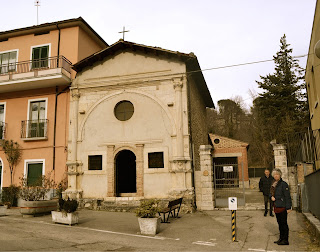
It doesn’t take long for a small village to get wind of a large international community of artists plunked down in their midst. My plunk came last Sunday, when I attended the local church of my host family. A tiny gem in the heart of the village, its ancient facade camouflaged a contemporary interior that had the sense to preserve stone walls and vaulted brickwork. The church quickly filled with about 50 people—not bad for a European church.


Though translation was offered, I respectfully declined. Translation can tie you up in knots after you reach a certain level with a language. It was time to ‘let go of the rope.’ If I was going to learn this language, I needed to cut off my own, even if only for 2 hours.
And two hours later…let’s just say language immersion can do a girl in! But I survived and earned points from those who understood what it is to endure immersion to learn a language. Others were convinced I understood Italian, a notion that quickly evaporated as they plunged into conversation and I had to call for a translator. Several languages were fractured that night, but I made progress—in both Italian and relationships.
Marco preached that night, in the absence of the pastor. He chose his words carefully and spoke slowly, making it relatively easy to follow him. Projecting a beautiful piece by Gauguin for our contemplation as he spoke—the beauty of the image speaking volumes into our right brains, while our left ones chugged along in language. Well done, Marco! I thought. Well done. Theresa leaned over and whispered that he was a great artist. I must meet him.
 As Marco’s sermon ended, along with the service, there was a flurry of handshakes and kisses. All the artists in the church were pointed out or introduced to me, but when Marco approached, the crowd parted like the Red Sea. A volley of Italian burst out of him, his eyes piercing me as if searching my soul. I sensed the thirst of the isolated artist for connection, understanding, hope.
Marco’s story unfolded, through the translator: a master ceramic painter, he had worked as a professor at a local high school famed throughout Italy for its ceramics. Heads nodded as the translator tried to impress upon me the stature of the artist before me. I looked at Marco, who shrugged as if to say, “Whatever.” The crowd waited for my reaction and I summoned one of the few words I know, but which I delivered with the utmost Italian gusto: “Bravo!”
“Now I work in the local middle school, with children with special needs,” he replied through translation, with an air of resignation.
“Maybe you could speak at our school,” i suggested and his eyes lit up.
“Absolutely! Any time!” he responded, and the crowd nodded again, satisfied that I had offered an honor befitting the artist. The poor translator, sweating under the strain of resurrecting whatever English he knew, nearly fainted when my hosts (below) came to extricate me from the crowd.

Before I left, however, Marco invited me (and all our students) to visit the famous high school in the nearby mountaintop village of Castelli. The following Saturday was an open house.
“Absolutely!” I replied in return. And went home to recover.


Though translation was offered, I respectfully declined. Translation can tie you up in knots after you reach a certain level with a language. It was time to ‘let go of the rope.’ If I was going to learn this language, I needed to cut off my own, even if only for 2 hours.
And two hours later…let’s just say language immersion can do a girl in! But I survived and earned points from those who understood what it is to endure immersion to learn a language. Others were convinced I understood Italian, a notion that quickly evaporated as they plunged into conversation and I had to call for a translator. Several languages were fractured that night, but I made progress—in both Italian and relationships.
Marco preached that night, in the absence of the pastor. He chose his words carefully and spoke slowly, making it relatively easy to follow him. Projecting a beautiful piece by Gauguin for our contemplation as he spoke—the beauty of the image speaking volumes into our right brains, while our left ones chugged along in language. Well done, Marco! I thought. Well done. Theresa leaned over and whispered that he was a great artist. I must meet him.

Marco’s story unfolded, through the translator: a master ceramic painter, he had worked as a professor at a local high school famed throughout Italy for its ceramics. Heads nodded as the translator tried to impress upon me the stature of the artist before me. I looked at Marco, who shrugged as if to say, “Whatever.” The crowd waited for my reaction and I summoned one of the few words I know, but which I delivered with the utmost Italian gusto: “Bravo!”
“Now I work in the local middle school, with children with special needs,” he replied through translation, with an air of resignation.
“Maybe you could speak at our school,” i suggested and his eyes lit up.
“Absolutely! Any time!” he responded, and the crowd nodded again, satisfied that I had offered an honor befitting the artist. The poor translator, sweating under the strain of resurrecting whatever English he knew, nearly fainted when my hosts (below) came to extricate me from the crowd.

Before I left, however, Marco invited me (and all our students) to visit the famous high school in the nearby mountaintop village of Castelli. The following Saturday was an open house.
“Absolutely!” I replied in return. And went home to recover.
Subscribe to:
Comments (Atom)